








The human population is currently eight billion people. While this is the highest that it has ever been, it’s no surprise. Simple math—the potential for each fertile woman to have one hundred and twenty children or more and each fertile man to father millions of children per day—suggests the potential for rapid population growth, once child mortality fell.
Overpopulation was first predicted centuries ago; steadily increasing population has been documented almost as long. Writers of science fiction have embracing this trend for plot purposes almost since the rise of the genre. There are far too many works to survey in full. Here are five that are worth reading, if you haven’t read them already.
The Caves of Steel by Isaac Asimov (1954)

Earth’s swarming eight billion people are confined to densely populated cities, leaving the countryside free for agriculture. Virtually every aspect of daily life is shaped by this stupendous population. Sustaining it is challenge enough. Too bad for Earth that other crises loom.
The situation is exacerbated by the balance of power with Earth’s ungrateful children: their three and a half billion, scattered across fifty “Spacer” worlds, greatly outmatch Earth economically and militarily. Open conflict wouldn’t favour Earth.
Spacer scientist Roj Nemennuh Sarton has been murdered; this could spark war.
New York cop Elijah Bailey discovers that not only is he assigned the crucial case, he will be working with a Spacer robot, R. Daneel Olivaw. Earthmen are known for many things but a love of robots is not among them. However, prejudice cannot be permitted to interfere with an quick solution to the looming crisis.
It could be argued that the eight billion humans are crammed into cities only partly due to land management issues. It’s also because Asimov genuinely liked densely populated cities. What some readers might have assumed was intended as dystopic seems to have been paradise to the good doctor.
Time for the Stars by Robert A. Heinlein (1956)
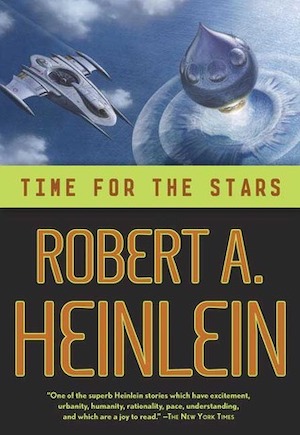
Five billion humans, teeming on a world where two and a half billion had struggled to feed themselves, survive thanks to harsh coping mechanisms. These include firmly enforced limits on the number of children parents may have. Twins Pat and Tom put their family over the limit. Their father’s stubborn one-man tax protest consigns the family to poverty.
Escape presents itself in the form of a curious ability neither teen knew they had: telepathy! Telepathy alone can span interstellar distances instantly. Thus, telepathic pairs like the twins provide the only means for Earth to remain in contact with its sublight exploration teams. However, only one twin can escape overcrowded Earth. The other will remain behind. How, then, to pick the lucky twin?
Which twin is lucky and which unlucky is an interesting question. On the one hand, Earth is crowded and getting more crowded. On the other, the death rate among the explorers is appalling. The twin who leaves Earth is very lucky that the narrative is first person.
You may be wondering how it is that a civilization that commands energy sources that can power relativistic starships hasn’t somehow harnessed that energy to the production of food. I certainly did…
Make Room! Make Room! by Harry Harrison (1966)

Of the seven billion frantically breeding humans on Earth, three hundred and fifty million of them call the United States of America home. By 1999, one in ten of them live in New York City. New York City is overcrowded, its infrastructure barely functional, crime is rampant, and life for the little guy is, in a word, hell.
Billy Chung deals with life in hell by commandeering the resources of the rich. In other words, he is a petty criminal. Andrew Rusch is a NYPD cop, whose job is catching people like Billy. One of Billy’s robberies goes horribly wrong, leaving well-connected hood “Big Mike” O’Brien dead. It’s a case that demands swift solution: bad news for Rusch and Chung.
Generally speaking, it’s never a good sign when SF novels about the population bomb mention Chinese people. This novel is no exception to that rule. However, with the possible exception of the Danes, noted to have very sensibly embraced zero population growth and sealed themselves off from the world, Harrison doesn’t seem to like most of the characters in this book, or the species to which they belong. The good New Yorkers are ineffectual and the rest are ignorant, greedy, and destructive.
This is the book that introduced the world to Soylent Green… well, almost. In the book, it’s just Soylent, period, and it is meat-substitute made from soy and lentils and nothing else. Filmmakers decided to sex it up a bit.
Stand on Zanzibar by John Brunner (1968)

If the whole of Earth’s seven billion were to stand shoulder to shoulder in this, the year 2010, they would cover the island of Zanzibar. The soaring population drives crowding, social breakdown, endless bickering between rival nation states, and justifies draconian eugenic laws. Thus far, human civilization has managed to keep functioning. How long can it keep up the juggling act?
The proudly nationalistic island nation of Yatakang proclaims a genetic engineering breakthrough. If Yatakang’s claims are true, they have in their hands a game changer. America must have the secret or, if it cannot, it must somehow deny the breakthrough to other nations. A deadly game of espionage ensues, but it may be only a sideshow to more important events in Africa.
As dystopic overpopulated worlds go, Brunner’s is actually rather nice. The Cold War seems long over, and the various horrors are not as all-encompassing as one might expect—doled out retail, not wholesale. It’s all very stressful, but (like a frog in monotonically warming water) experience suggests civilization can continue coping indefinitely.
The Lathe of Heaven by Ursula K. Le Guin (1971)
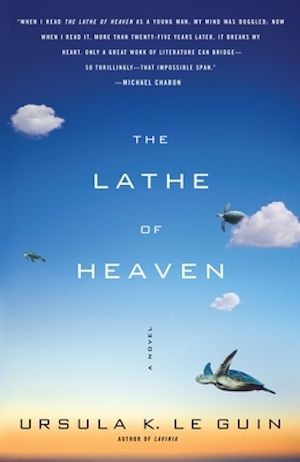
Dr. William Haber dreams of a better world, one in which humanity’s seven billion were not forever imperiled by the consequences of their numbers: dramatic environmental decay, food shortages, and the inevitability that Cold War tensions will soon spiral out of control and into atomic Armageddon.
Haber finds common ground with George Orr, who also dreams of better worlds. The difference between the two men is that when Orr dreams, the world reshapes itself to fit his vision.
Orr saved the world from nuclear war in 1998, dreaming into existence a reality where he was not dying in the aftermath of World War Three. Haber is certain that under Haber’s hypnotic control, Orr could rid the world of all of its imperfections. Haber is about to receive a personal lesson in the meaning of hubris.
Orr is essentially a genie in this story, the sort who delivers exactly what was wished for without concern for secondary implications. Probably there’s a story out there where the guy giving the genie its marching orders learns the error of his ways. This isn’t one of those stories. Haber is more of a cautionary tale guy.
***
The population bomb was a popular subject in its day. SF authors were ingenious in their solutions, whether it was storing brains in boxes, dispatching UN cops to arrest illegal mothers, or simply orchestrating global thermonuclear war to thin the herd a bit. You may have your favourite examples. If so, please mention them in comments below.
In the words of fanfiction author Musty181, four-time Hugo finalist, prolific book reviewer, and perennial Darwin Award nominee James Davis Nicoll “looks like a default mii with glasses.” His work has appeared in Interzone, Publishers Weekly and Romantic Times as well as on his own websites, James Nicoll Reviews (where he is assisted by editor Karen Lofstrom and web person Adrienne L. Travis) and the 2021 and 2022 Aurora Award finalist Young People Read Old SFF (where he is assisted by web person Adrienne L. Travis). His Patreon can be found here.

The folks who run the ruinously overpopulated planet Gideon went to the trouble of (presumably stealing and) researching Starfleet personnel medical records, constructing an exact, ground-based duplicate of USS Enterprise, and kidnapping Captain Kirk, just to get a blood sample so they could infect the High Council’s representiative’s daughter with Vegan choriomeningitis, in order to derive an infectious viral agent to cull the population. All in all, a seemingly roundabout way of going at it.
I see what you did there! The population in each of those novels is less than Earth’s population right now. I’d suggest it’s another example of the failure of imagination of SF writers.
I noted the same thing in Robert Silverberg’s first full-length (for slimmish values of “full-length”) novel Master of Life and Death, which features an overpopulated Earth (7 billion!) with a proposed solution: send people to planets around another star via starships. No mention was made of how that math would work … At least Heinlein acknowledged the issue even using teleportation gates. Alas, the Silverberg novel, being his first and also written while he was in full hack mode, is not very good at all.
The cabal behind all the intrigue in the excellent series Utopia (British version, of course) also have some thoughts about dealing with population growth.
There’s also 1972’s Z.P.G., in which Oliver Reed and Geraldine Chaplin decide to go for the real thing instead of a robot child, with unfortunate consequences. (I admit I haven’t seen it, and only know of it because I remember the adverts for it from when I was younger, but I have to assume that the consequences were unfortunate, it being a 1970s dystopian sci-fi film, after all.)
I suppose I haven’t really read all that many stories involving overpopulation other than the ones mentioned in the article, so I’ll throw in Raccoona Sheldon’s (yes, I know) ‘The Screwfly Solution’ — which isn’t exactly an overpopulation solution so much as just a population solution. Not sure it counts, but it’s a fabulous story anyway.
A lot of Larry Niven’s Known Space stories have a seriously overpopulated Earth as background. The most obvious example is Ringworld‘s Teela Brown, who is supremely lucky thanks to being the end product of generations of people winning the Birth Lottery. A closer look can be found in the story “Flatlander” wherein Beowulf Schaeffer is overwhelmed by many of the accommodations Earth people have made to living in overcrowded quarters.
The Earth in Peter F Hamilton’s Night’s Dawn trilogy is mostly uninhabitable (due to global warming), with the Earth’s billions living crammed in domed cities, or emigrating to colony planets if they can afford it.
I’d note that, even with 350 million people, the US is mostly empty. If the US as a whole had the population density of, say, Germany, we’d have over 2 billion people.
Logan’s Run. I never saw the movie, which I understand was different, but in the book everyone is expected to turn themselves in to die at age 21. Even when I first read it as an early teenager, I wasn’t sure how that worked with new generations – yeah, women could have babies well before 21, but *someone* needs to raise the kids and not disappear on them. But my recollection (it’s been decades since I read it) is that it was handwaved away. I guess it’s not something the cool kids worried about.
What, nothing by Sherri Tepper? She had ideas about population even before she spent twenty years working for Planned Parenthood.
@7 Pretty much. In Logan’s Run (at least the book) kids are raised via robots and hypnotape till age 7, then go on an extended wanderjahr with food and accommodations free till 14, at which point they’re somehow expected to be ready for adulthood. Granted, there aren’t a *lot* of adult responsibilities, but they need to get Sandmen and various skilled workers somewhere. And no one lasts more than seven years max in a career, so turnover would be pretty constant.
In re footnote 6, I’ve always remembered the bon mot in the middle of this:
‘Until recently baby production was largely dependent on slave labour; as soon as women are allowed to answer the question “Would you like to squeeze as many objects the size of a watermelon out of your body as it takes to kill you?” they generally answer “No, thank you.” This leads to falling birthrates everywhere women are not kept enslaved and ignorant of the alternatives.’
The author, of course, is Our James.
We can always do Frank Herbert’s Dosadi Experiment – overpopulation surely should include craming millions of people into a small area filled with environmental poisons to see whether the survivors would develop enhanced skills.
Tuf Voyaging is in part about overpopulation, on a scale an order of magnitude larger than James’ 5 examples.
The Mote in God’s Eye is also in part about overpopulation.
I’ve always felt that the moral of The Lathe of Heaven was less about hubris and more about being on the wrong side of the point that the author was trying to prove.
Anne McCaffrey’s Decision at Doona tells the story of two races trying to bleed off their surplus populations to uninhabited planets. There’s a bit of tragic backstory which explains why neither race is predisposed to contacting the other. Then contact happens. Oops.
Heinlein’s juveniles often gad overpopulation in the foreground. Farmer in the Sky had food rationing that the characters saw as normal.
My only recollection of The Caves of Steel was that the women would chat in the public restrooms, whereas the men refused to acknowledge the presence of one another.
There’s a story in one of the Dangerous Visions, where people live alone in an overpopulated world. Babies don’t take up much room, so you’re allowed to have all the children you want, until they reach the age of four or so….
“Soylent is a meat-substitute made from soy and lentils”
Soy-Lent
How did I not realize this until now?
@1 That episode of Star Trek was the first one whose blurb I read in TVGuide, though *not* the first one I watched. The description looked very interesting, so I started watching the show. I was extremely disappointed months later when it came back around in syndication and I finally got to see it.
Most of the overpopulation extrapolations assume food production stays constant, which it very much didn’t. I don’t recall any SF that even came close to applying any science to farming, though I suppose “there are lots of well fed people” doesn’t make for interesting stories.
The recently-mentioned Heechee series by Frederick Pohl (starting with Gateway) is written with a severely overpopulated and underfed Earth as the main motivation for most human activity in the books.
In Gateway, before he won the lottery ticket to the Gateway asteroid, Robinette Broadhead worked in a shale oil mine to retrieve petroleum that was used to feed torula yeast for humans to eat.
In Heechee Rendezvous:
* terrorists in an underprivileged country blew up a Lofstrom Loop spacecraft launcher.
* after humans had semi-mastered Heechee space travel, a large Heechee spaceship is repurposed to make nonstop trips back and forth between Earth and another habitable planet, bringing hundreds of thousands of refugees per trip to a new home. (Life was still terrible in both places.)
* Broadhead’s wife S. Ya runs a company that uses Heechee tech (discovered in Beyond the Blue Event Horizon) to manufacture food out of raw CHON (carbon, hydrogen, oxygen, nitrogen) elements.
It’s been a long time since I read James Blish’s “A Torrent of Faces”, but my recollection is that despite having a trillion people Earth was *not* considered overpopulated. It had a highly regimented society to keep the machinery running, but (IIRC, which I may not) it was portrayed more neutral-to-positive than dystopian.
(Though readers’ opinions might vary. Like many SF authors of the era and since, his futures don’t have a lot of room for democracy. Even the Mayor of New York in Cities in Flight was IIRC elected by the computer bank known as the City Fathers, not the citizens.)
@17 The Green Revolution came as a pretty big surprise, not only to SF writers but to scientists. If not for Norman Borlaug the Malthusian disaster very likely would have happened in the 1980s or 1990s.
@17 A lot of the stories apply science to food production, but assume that the results will be obviously inferior: Asimov’s zymoveal, Pohl’s Chicken Little, Lazarus Long turning his nose up at syntho sirloin.
The idea of using it to multiply crops either doesn’t occur or is assumed to disappear into Malthusian exponentials, doubling crop yields while the population quintuples.
6: If we consider volume and not area, the human population of the planet is probably only 800,000,000 cubic meters. Provide a munificent 10 cubic meters each, to allow for food, water, and waste tubes, as well as heat management and pain clamps, and we’re talking a cube only 2 km on an edge.
@NomadUK The ending of the movie ZPG is in fact positive: Russ McNeil (Oliver Reed) and his wife Carol (Geraldine Chaplin) know where they will be taken for execution when their secret child is discovered and prepare the square beforehand so they are able to escape. I’ve only seen this movie once, when I was about 10, but it made a lasting impression on me and was instrumental in my admiration of Reed as an actor – he could rise to thespian brilliance when he wasn’t drunk and thus aggressive and belligerent. The movie is available on Youtube so a re-watch over the Christmas break is on the cards for me.
There’s a lot of it about. Here are eight more.
1. Overpopulation is also at least implied in “The Marching Morons.”
2. I posit that footnote #3 should have at least mentioned T.R. Malthus.
3. It’s only a short story, but germane to this topic one might mention J.G. Ballard’s lovely bit of irony “Billenium.”
4. Zelazny. The Dream Master (or the slightly shorter “He Who Shapes”).
5. A couple more short stories with related themes: Farmer’s “The Sliced Crosswise Only On Tuesday World” (which eventually got expanded into Dayworld and sequels), and Lafferty’s “Slow Tuesday Night.” (Interesting that they both chose Tuesday.)
6. There is no Rule 6.
7. Another one of those “concentrate them all in cities,” or in this case tower-cities, tales: Silverberg, The World Inside.
8. T.J. Bass, Half Past Human, another somehow-feeding-countless-billions story.
Malthus’ main issue was that he didn’t anticipate the effect tapping the underground cache of solar energy, gathered over millions of years and consumed in a single century would have on agricultural production; particularly with respect to synthesis of fertilizers (80% of Natural Gas is used for fertilizers). Once that cache is economically exhausted (and it’s on the decline now), then Malthus will largely be shown to have accurately predicted the future, just offset by a few years.
Malthus’s main error was not so much to do with food production as that he regarded the fertility rate as an unalterable social constant. Even before chemical contraceptives, it really wasn’t–it just seemed that way in England of his time.
There’s Tuf Voyaging categorized by the always reliable Wikipedia /s as a fix-up novel by George RR Martin. S’uthlam is a world with a population of 30 billion and a religious and philosophical idea that increasing population is the goal.
“Somewhat uncommonly for the time, the novel acknowledges how easy it is for elites to weaponize eugenic laws against minorities.” (FN 5)
In the United States, they were weaponized against minorities, generally through sterilization of women: Latinas (esp. in California and Puerto Rico), Native Americans, and African Americans. In 1968, when Brunner wrote the novel, I have no doubt that he was aware of this, particularly since the disproportionate application of these laws against PoC would have become better known in light of the civil rights movement.
Pohl and Kornbluth’s The Space Merchants is set on an overpopulated Earth. Corporations rule the world, and they want the population to keep on growing to suppress wages and create consumer demand.
I’ve never understood why this one doesn’t get inducted into the Prometheus Hall of Fame. It’s the most honest Libertarian novel I’ve ever read.
@25
The “do the math” blog by Prof Tom Murphy just published an interesting article about this topic.
https://dothemath.ucsd.edu/2022/12/finite-feeding-frenzy/
Many a SF author did not leave some math being in the way of an interesting idea, see Asimov and Trantor in this same article…
@22: Pain clamps?
My Geography teachers taught that families in poor, low-tech societies, with high child mortality, will have many children, in the hope that some will survive to support their parents in their old age. As conditions improve, the inhabitants continue with that policy for some time, resulting in a surge in population. However, as people begin to appreciate that most of their children will now prosper, they tend to have far fewer, aided, of course, by the availability of various methods of birth control. Populations will go down. In fact, there have been warnings of population “implosions” in areas such as Western Europe, with parents failing to have enough children to maintain the existing population density, let alone increase it.
I wonder if there are as many stories to be written about population decline as population explosion?
19: Blish was a self-described fascist, of the “all the real world examples did it wrong and don’t count” variety. Torrent of Faces (which the author says in the intro is intended as a fascist utopia) was regimented in part because
“[…] the leaching out of the gene-pool, which took place while the population was reaching its current peak, has left us with a high majority of pure thump-heads.”
I suppose the only thing one can really say is that correlation is not causation.
Reference to Malthus at this time of the year inevitably brings to my mind Scrooge’s admonition to the men who come to his office asking for a charity donation for the poor and destitute: “If they would rather die, they had better do it, and decrease the surplus population.” Which the Ghost of Christmas Present turns around and throws back at him when he shows evidence of concern for Tiny Tim, after the Spirit has told him “the child will die”: “What then? If he be like to die, he had better do it, and decrease the surplus population.”
Judith Merrill seems to have thought Blish was trying to get a rise out of people. ‘Merril would frequently dismiss Blish’s self-description of being a “paper fascist”. She wrote in Better to Have Loved (2002), “Of course [Blish] was not fascist, antisemitic, or any of those terrible things, but every time he used the phrase, I saw red.”’
I don’t know enough of his biography outside his writing to know if she’s right, but she knew him and I didn’t. And “oh, he was just trolling people” isn’t perhaps the most robust defense in the world even if one finds it convincing. But FWIW.
Heinlein also touched on overpopulation in Farmer in the Sky. There are numerous references to the Earth being overpopulated–the narrator lives in “Diego Borough,” which seems to be a Southern California megapolis of high-rise apartments, and most food is various kinds of “syntho” products. As a consequence, people are being encouraged to colonize terraformed Ganymede, both to siphon off population and to (hopefully) produce surplus food for shipment to Earth.
Similarly, in The Moon Is a Harsh Mistress, grain shipments from Luna are deemed essential to feed an overpopulated Earth.
@24
“2. I posit that footnote #3 should have at least mentioned T.R. Malthus”
Footnote 3 directly followed a link to the Wikipedia page on Malthus’s famous essay.
@0, re note 6: cf the mot “Human beings are not rational animals; they are rationalizing animals.” The ZPG newsletter repeatedly notes how birthrates go down when women get access to contraception — but getting them access in male-dominant societies is non-trivial.
@15: you may be thinking of “Soundless Evening”, by Lee Hoffman.
@32: a number have already been written, of widely varying quality. I hope you’ve given our host an idea for another column.
@32 – A Boy and His Dog at The End of the World and The Children of Men come immediately to mind, as does Clarke’s Childhood’s End. The genre goes all the way back to Mary Shelley’s The Last Man.
There’s a 1962 Frederick Pohl short story, “The Deadly Mission of P Snodgrass”, in which a man from the 20th Century travels back to Roman Empire times to give the Classical world the benefits of modern health, hygiene and science. Unfortunately he fails to foresee the impact on population growth, leading to a drastic solution many centuries later……
32: I tackled decline in 2018
https://www.tor.com/2018/06/11/why-are-there-so-few-sff-books-about-the-very-real-issue-of-population-decline/
No doubt room for another stab at it. Maybe this time I will find an elegant way to convey the idea of population decline driven entirely by personal choice, not calamity.
Since most of the more well-known books I came here to mention have already been highlighted in earlier comments, I shall content myself with adding a relatively fairly obscure one – the Cageworld series (by Colin Kapp I think). Alas, I don’t recall much detail, having only laid hands on the first book, Search for the Sun (in a library in my childhood decades ago) – but I do remember the solar system was filled with giant rings, one at each planetary orbit (I suppose somewhat resembling Dyson spheres, though I didn’t know the terminology then!) and this huge edifice (?) was nonetheless overpopulated. (Duh, now I am curious to know how things proceeded in the sequels, but I don’t know if those books are even in print any more!)
I think SF Gateway has the whole series in ebook but they tend to focus on UK rights.
@22: That would be a very efficient setup to allow those humans to generate the bioelectric power needed to run vast AI networks!
(The setup in The Matrix would be far less preposterous if it had been based on the premise that the AIs need the computing power of the billions of human brains. As long as they stayed away from the silly “we only use 10% of our brains” meme.)
@35: That’s not a coincidence. Dickens was deliberately criticizing Malthus, who had argued that almost any effort to help the poor is counterproductive because it only causes them to breed past the limits of the food supply. See this blog post for more details.
All of these books came out during or just after the baby boom. Since the late1960s Russia, Europe, and the US have had negative birth rates. All of the population growth is coming from the third world so overpopulation stories are not cool anymore.
Robert Silverberg’s fix-up novel «The World Inside» (1971) – one of the best on the subject!
Trying to remember a book I read decades ago. In it a planet is compelled by their b
Trying to remember a book I read decades ago. The beings are compelled by their biology to over reproduce. They also have a mysterious building they cannot open. Their overpopulation causes their civilization to collapse into a stone age time. At some point they can contact Earth somehow who come to try to help. The earthlings are advanced enough far enough to open the bldg. Anyone remember title & author?
The Mote in God’s Eye by Niven and Pournelle, followed 20-odd years later by The Gripping Hand.
Just read synop
Sis of “Mote…”.I know I read it yrs ago, but that’s not it. The 2 key points I remember are the intense biological drive to reproduce & the mysterious building they can’t access. Don’t remember how earthlings came to their planet, but inhabitants wanted them to find a birth control method for them. Turned out access to the building required a certain level of development which the humans had . They opened it & found a repository of science to guide the natives out of their shattered civilization to progress. I want to read it again!
Yeah, that’s The Mote in God’s Eye. The Moties have an intense biological drive to reproduce, their population has an endless boom -bust cycle that ends civilization periodically, there are museums in the mountains that the human expedition accesses which tell the history and have details to help a new civilization rebuild. I suppose it’s possible someone else did a different version of it, but your description is Mote to a T.